Author: theoderic_liu

  • Global Top Trading Partner Dashboard: China vs. EU vs. U.S.

    Global Top Trading Partner Dashboard: China vs. EU vs. U.S.

    View the dynamic report here.

    Key takeaways
    • As of 2023, China is the largest trading partner with the rest of the world compared to the European Union and the United States
    • Total trade, sans trade with each other and intra-EU trade, increased for all three top trading powers
    • China’s trade with the rest of the world increased by more than 1,000% between 2002 and 2023 ($323 bn to $3.64 trillion), where as EU and U.S. trade increased by approx. 160% during the same period.
    • By number of countries with each as its top trading partner, China overtook the U.S. in 2009 and the EU in 2019. By total trade value, China overtook the U.S. in 2020 and competes with the EU between 2021-2023.

    Introduction

    Many articles and maps show how China overtook the United States as the world’s top trading partner in dollar terms in the last 20 years. Comparatively fewer comparisons take the European Union into account. As a bloc, the European Union account for 17% of global trade in 20241, valuing around 5 trillion dollars. With heightening global tensions and calls within the EU for greater strategic autonomy, EU could emerge as a significant player in the new era of international relations and trade. Therefore, it is important to account for the European Union when analyzing how the international trade system has changed over time.

    Methods

    Annual trade data for the EU2, United States, and China are extracted from Eurostat, U.S. Census Bureau, and the Havard Growth Lab respectively. Due to different data entry standards, time spans, and geographical extent, the data are first loaded in to Excel for initial cleaning before being further cleaned, transformed, and merged in Power Query. Trade between China, the EU, and the U.S. is excluded, as is trade between EU countries so as to focus only on how the three powers stack up against each other in the competition for the rest of the world’s trade. The result is a long table with each row representing one country or territory in a given year between 2002 and 2023 and three columns with values of the total trade volume (import + export) that country had with the European Union, United States, and China.

    GIF of a map of the top trading partner of countries around the world between 2002 and 2023

    Figure 1: GIF showing how the top global trade partners changed between 2002 and 2023

    Findings

    As expected, China is the world’s leading trade partner by both total dollar value and the number of countries which has it as the largest trade partner compared to the EU and the United States. In 2023, China led the pack with $3.64 trillion in total trade and was the largest trading partner of 77 countries. The EU followed in second with $3.6 trillion and 61 countries. The U.S. came in last at $3.53 trillion and 25 countries.
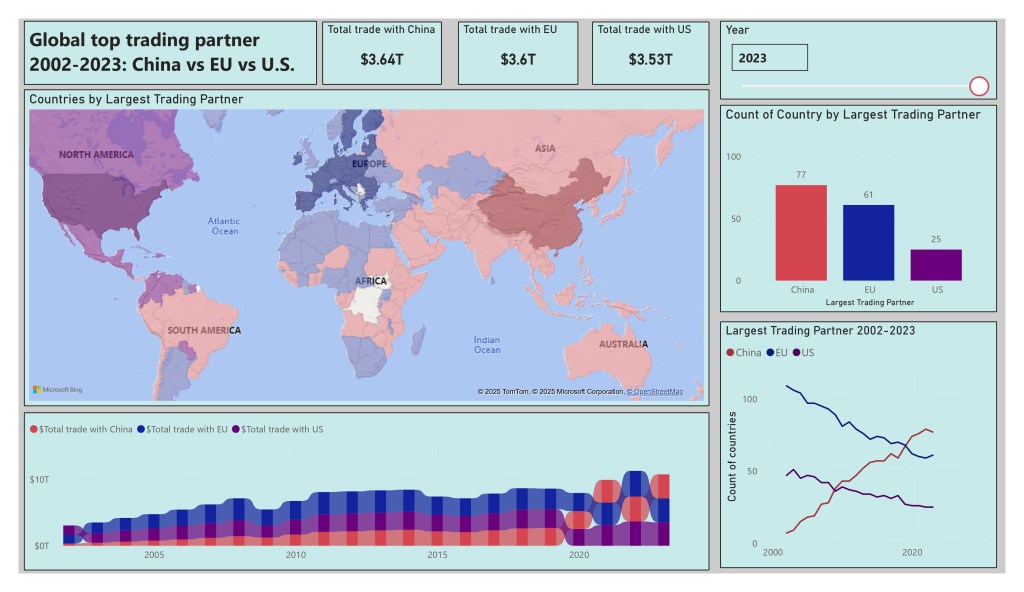
    Figure 2: Snapshot of the global trade situation in 2023

    Despite China’s seeming dominance in global trade, the competition remains fierce. A few points to keep in mind:

    • Although China overtook the U.S. and the EU by number of countries with which it is the largest trade partner in 2009 and 2019 respectively, it has only managed to overtake the U.S. by total trade value in 2020 and is still competing for the top spot with the EU as of 2023.
    • The total trade value of the three trading powers are very close, with only 3% of difference between China at number one and the U.S. at number three.
    • The U.S. and the EU, when combined, still outweighs China in international trade. This highlights the importance of the transatlantic alliance in checking China.

    Regional spotlights

    Unsurprisingly, each of the three top trading powers are strongest in their respective neighborhoods.

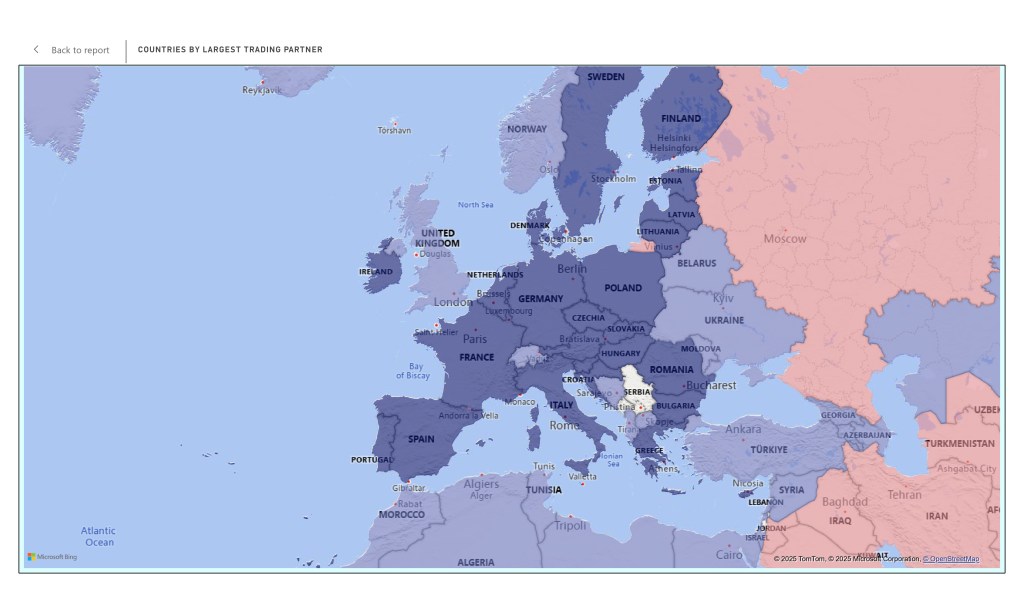
    Figure 3: From left to right: Trade in Asia-Pacific, Europe and the Mediterranean, and North and Central America are dominated by China, the EU, and the U.S. respectively.

    However, some areas are still contested between China, the EU, and the U.S. Africa is split between the EU–which is strongest in the northern and southern edges of the continent–and China, which is strongest in East Africa and has gradually grown in influence in Central and West Africa. Meanwhile, South America is contested by all three, with countries on the northern end of the continent (Venezuela, Colombia, Ecuador) trading more with the U.S. and the major South American economies of Brazil and Chile trading the most with China. The EU has managed to retain its top trading position in Argentina and Guyana.

    Figure 4: Africa and South America by top trading partner, 2023

    Conclusion

    Despite the historical dominance of the EU and U.S. in global trade, China has rapidly caught up to them by 2023. China is now the world’s leading trade partner, with the highest trade value and the most countries having it as the largest trade partner. The EU remains a significant player across the globe, especially in Africa, the Middle East, and rest of Europe. The U.S., though dominating less countries in terms of trade than the others, remains very close to China and the EU in total trade value. Overall, the competition for global trade is far from settled and will likely heat up as tensions and uncertainty rise in the coming years.

    Notes

    1This figure is derived by taking the total global trade volume of 2024–33 trillion dollars, and subtracting it by the volume of intra-EU trade at 4 trillion dollars, as we are treating the EU as a single trading bloc. The subsequent figure of 29 trillion dollars is then used to calculate the relative proportion of extra-EU trade, which is around 5 trillion dollars.

    2Eurostat retroactively includes all current EU member states (the “EU 27”) and excludes the United Kingdom from its historical trade dataset. As such, for consistency, this project will not reflect the changing EU membership (13 accessions and 1 departure) in the two decades between 2002 and 2023.

    References

  • A center of gravity analysis of major world religions

    In cartography, a center of gravity represents the midpoint between different weighted locations. It is a commercially useful tool to select locations that minimizes distance to locations and clients. For example, you can use this to select warehouse locations to maximize delivery efficiency–with each location weighted by the number of orders to be fulfilled.

    In this case, I wanted to see where the demographic “centers of gravity” of major world religions. For each country and territory, I generated a geographic centroid, added data for the number of adherents of four selected religions–Christianity, Islam, Hinduism, and Buddhism–and generated a center of gravity for each religion where the number of adherents in each country and territory served as weight.

    It’s a simple map: the source for the number of adherents is Wikipedia. The countries and territories shapefile I downloaded from opendatasoft. I did have to make some adjustments when generating the geographic centroids as some countries (cough* the United States) have far-flung, sparsely populated exclaves that mess with the location of the centroids. Otherwise, it’s a lot of joins by attribute and adjusting labels and symbology. Anyway, enjoy.

    For the most part, the centers of gravity turned out to be roughly where I expected them. Hinduism, despite significant number of adherents in such distant places like Canada, remains a decidedly Indian religion. Buddhism, on the other hand, pulled by the hundreds of millions of believers in China as well as huge numbers in Japan and Korea, has moved out of the Indian subcontinent deep into China (roughly where I originated, Sichuan).

    Islam is a bit more surprising. I had expected its center to shift further southeast on account of the large number of muslims in South and Southeast Asia–the three countries with the most muslims are Indonesia, Pakistan, and India–and yet, it clings stubbornly on the edge of the Arabian Peninsula, where it originated 1400 years ago.

    Christianity was always going to be the wildcard. If you asked me to guess where the centers of gravity of the three other religions were before I made this map, I would probably have been at least somewhere in the ballpark. With Christianity, I would have had no idea. From its old stronghold in Europe it had accompanied every colonial boat to the North and South Americas, to South and East Asia, to Sub-Saharan Africa, and to Oceania down to the tiniest inhabited island. Keeping in mind that I calculated the centers of gravity using mean geographic coordinates, it probably isn’t coincidental that its current location in Mali, not too far from Timbuktu, is remarkably close to the “null island”: the exact intersect point between the Eastern, Western, Northern, and Southern Hemispheres.

    The distance between Christianity’s center of gravity and the 0, 0 coordinate point (null island) is about 1217 miles

    In the future, I may make a series exploring how these centers of gravity changed over the centuries or how they would look like using a spatial median approach instead of just calculating mean coordinates (which ignores the spherical surface of the earth).

    Happy to hear any feedbacks or questions!

  • Christmas Candle

    I was pretty depressed when I got up. 12:00 p.m., raining. It was the first proper rain of the year, I think.

    I was scrolling Twitter when I saw a woman burnt alive on a New York subway train. The cops walked by, and the bystanders took out their phones with a proficiency that anthropologists might assume is instinctual. One man seemed like he was trying to help, fanning his jacket a couple of meters away. It didn’t work. Later, it turns out he might be the perpetrator who set the woman on fire in the first place.

    Even the woman herself, standing and ablaze, didn’t seem to care. Movies and video games made me believe that a person on fire would run around screaming at the top of their lungs or roll on the ground in a furtive attempt to put themselves out. If they showed someone standing perfectly still while on fire, people would say it’s unrealistic. Perhaps the directors and developers never actually saw a woman set on fire before.

    Nothing in this video made any sense. The indifference of the cops, the apathy of the bystanders, even the lack of reaction of the woman herself, like a human-shaped Christmas candle.

    Even how quickly I got over the horrible images I just saw. As instinctively as the bystanders who pulled out their phones, I scrolled on. Behind the screen, the world’s brightest scientists and fastest supercomputers have picked out the worst things it has to offer. A garbage “hot take,” some stupid mobile game ads, a selfie with an attention-seeking caption…The bystanders, the city, the algorithm, and I have boarded the next train as the woman’s charred body slowly faded away from view.

    On that note, Merry Christmas. 

  • What adulting feels like: An eight-day reflection

    What adulting feels like: An eight-day reflection

    I originally planned to write an essay on how to deal with adulting–a guide on the subject, if you will. However, I felt completely overwhelmed by the task soon after I started. Though I had no trouble filling the pages, I filled them with platitudes. No matter how many words I put on paper, I struggled to say anything meaningful or make a coherent point. I watched in horror as the word counter bloated until it became a parody of a too-well-fed man, mocking my incompetence as a dietician. A new approach was needed. 

    I realized that I was trying to teach something I was hopelessly underqualified to teach. At any rate, adulting is an impossible subject. I could give tips—some of which might be helpful—but I couldn’t do so with any authority or confidence. So, I scratched everything I had written and decided to write about something that I am an expert—the expert—on: how adulting has felt to me. So, I went about my days as usual, except for taking the time to notice what I felt or thought about this whole adulting business. The results are below.

    Monday

    Do you know the feeling when it’s 8:00 p.m., you have several days’ worth of assignments due at midnight, you’ve not done a single thing all week, and you have no clue where to start? That’s what adulting feels like–constantly. Time, once a boundless ocean, has now shrunk to a dying lake, its fringes exposed to the merciless wind. Adulting is always running out of time.

    Adulting also feels like a lonely battle. It’s you against the world, and no help is forthcoming. It’s a last stand with no witness.

    Sometimes, my friends tell me I should be more cheerful. 

    Tuesday

    Some days, you get so busy that you forget how busy you are. It’s the fight response of the 21st-century fight-or-flight, where the body, long exhausted of its natural reserve of energy, is kept alive by the unnatural fuel of caffeine and adrenaline.

    Then you catch a break and let yourself collapse–soaking up the downtime like a dry towel in a puddle of water.

    Wednesday

    It’s been two months since I moved into my new apartment, and some of my stuff is still trapped in half-forgotten boxes in the corner. 

    Today, I finally found enough grit to open one. First, I found some photos, then a hand-drawn birthday card, then some old souvenirs that summon echos in my mind. I’ve opened my box of mementos.

    It took a while to get through everything. At first, I tried to find a home for each item in the gaps on my shelves, but that didn’t feel right. Everything seemed to connect to everything else, and I would be hiding horcruxes around my room if I separated them. They belonged together. 

    So, I cleared an area on my favorite shelf and placed each memento in a semi-circle so they all faced the viewer. Then, in the center, I seated the amulet and satchel of fragrances my mother gave me. With that, I made a shrine on the top of my shelf. It honors no particular deity but the worth of life itself. Moreover, it extends a transformative power over the space around it, turning my room from a place of abode to a place of shelter.

    Now, I try to take some time each day to contemplate in front of my shrine. Occasionally, I would add something to it. Years ago, I would’ve dismissed such behavior as sentimentalism or superstition, but I’m coming to terms with that.

    Thursday

    You can be sad about many things: losing someone close, frustrated hopes, or having to bear your burdens alone. 

    But you can also be sad about nothing in particular—or, rather, be sad about everything at once. You can suddenly be sad when, a moment ago, you were having the best time of your life. Sometimes, the sadness passes like a sunshower while, at other times, it hangs heavily in the air like a pending thunderstorm. It’s a sadness so shapeless that even the most eloquent tongues fail at description. 

    Yet, like pimples, we all catch this sadness at some point. It’s this sadness that makes you cry to your favorite songs and movies because they get you like no one will. And though we may sob alone, it’s comforting to know that, on the vast interweb, someone on the other side is crying to the same song.

    Friday

    Idle time is among those things that we only appreciate as grown-ups. It’s the temporal equivalent of porridge–bland, yet perfect to reset your palate after a feast. Spices and stimulation are as addictive as any drug, requiring ever-increasing quantities to achieve the same joyous effects. And, just as a palate used to heavy seasoning will struggle to taste subtle flavors, overstimulation of the mind will dull your capacity to enjoy the simpler moments of life. 

    Today, we are always doing something. Even when we are free from obligations, we fill the gaps with information, stimulation–things. The noise of things drowns out all feelings of existence to the point that you forget yourself, even lose yourself, in them. 

    I have been trying to go longer without doing anything—no task, no distraction, no noise. Sometimes, when it’s really quiet, I can hear the faint music of existence playing in the background. 

    Saturday

    It was raining heavily when I heard what sounded like a cat shrieking outside. I went to the window, but it was too dark to see what it was. The result of the debate that followed in my head was never in doubt, for though my room was warm and dry, my curiosity had already lept out of the window, and I knew I couldn’t call it back. So, I put on my jacket, ran downstairs, and opened the door to the outside–and all its dark, cold wetness. I swallowed my hesitation and rushed into the rain. Soon, I was awarded for my perseverance–a raccoon about the size of a large house cat was skulking under a tree about 15 feet in front of me. I took a step as lightly as I could manage, but it noticed me, scurried up the tree, and landed on top of the wall next to it. Now, we are locked in a stalemate as the rain grew heavier around us. I tried to parlay, offering terms of shelter and food if it came down and let me pet it, to no avail. And so, after about a minute or two, it scampered away as quickly as it came. I went back inside, drenched and shivering–but all the happier for it.

    Mystery solved

    Sunday

    With so many things taking up my time and energy, I’ve come to appreciate things that are clearly the result of effort. For example, I walked by a restaurant today. It had a patio semi-enclosed by planters about knee height. Inside is a mountain of succulents and other unnamed plants that have grown so well that they lept from one planter to another until they consolidated into a hedge. Yet, despite its mass, the succulent hedge is perfectly proportioned, with each leaf contributing much more than its meager self to the balance and beauty of the whole. Having tried my hands at growing succulents, I can recognize the hard work and care the gardener must have put into it. 

    I walked inside the restaurant and marveled at the equally well-arranged interior. The matching tables and chairs were placed just the right distance from each other. Pillowed couches lined the walls, spotless and welcoming. Even the striped wallpaper complemented the other furniture perfectly. Yet, no one was inside to appreciate this work of art except for me and a lone cashier. 

    I bought something partly because I was hungry, but more because I felt such effort of mind and hands deserved compensation. I sat on the patio. The succulents, still plump with the morning’s rain, shone brightly under the afternoon sun. I thought of opening a place like this myself one day and how much work that would take. I sometimes struggle with basic tasks like making phone calls and writing emails–and opening a restaurant must require making many phone calls and writing many emails! I recall someone telling me that nothing worth doing is easy. Perhaps he meant to motivate me; whether that worked, the jury is still out. In the meantime, I admit that no matter how much work it took to grow and prune those succulents, it was definitely worth it. 

    Monday

    The rain hasn’t stopped in 3 days–somehow, it only rains over the weekend this year. Heaven is displeased with us having fun, but I’ve run out of fuck to give. The music is on full blast–November Rain by Guns N’ Roses. I shouldn’t be driving this fast, but it would be a waste of a good song if I didn’t. As I sped along the freeway, the lights of the city opened up to me. What does adulting feel like? Top of the world.

    Post Script

    I began this essay back in November 2023–6 months ago. It took this long, not for its length or complexity, but because I got stuck. I had a pretty good skeleton of the essay soon after I started. But, I was quickly bogged down trying to find my voice in the scribbled lines of what I wrote. I had written a lot without saying anything. It was excruciating. Consequently, I procrastinated HARD, constantly finding excuses to not read or even touch the essay. And when I do summon up the gun-ho to “finish the essay” (a recurring guest on my calendar, so much so that it ought to start paying rent), all I end up doing is revising the same words and the same lines over and over again. 

    I should have realized sooner that I struggled because I wasn’t writing sincerely or honestly. I wanted to write about adulting, this much I knew. But, as soon as I laid down the first few lines, I stopped following my heart and, in its place, became a heartless bureaucrat handing out decrees on proper adulting–hence the original plan of writing a guide. The problem was that I didn’t have much to teach–since I was just as confused as anyone about adulting. Therefore, there was no audience that I could convince. 

    More importantly, by trying to make up nice, bullet-pointed tips, I had abandoned what compelled me to write about adulting in the first place: my feelings. I didn’t want to write about adulting because I thought I had some particular insights; I wanted to write about adulting because it had brewed up a storm inside me. In light of this, the change in the formatting and purpose of this essay is, in fact, a return to my original inspiration. It should be no surprise that I found writing to be much easier after that.

    Now, I stuck a note above my desk that reads, “Always write from the heart.” It is appropriate that my attempts to teach others ended up teaching me even more. – 4/17/2024

  • Which part of Los Angeles has the most Starbucks: A Density Analysis

    Which part of Los Angeles has the most Starbucks: A Density Analysis

    I lived in Westwood Village, Los Angeles, for over six years. It’s a charming college town amid a bustling city, distinguished from its surroundings by atypical walkability and an incredible concentration of boba shops and cafés.

    Map 1: Westwood Village. The idyllic name contrasts with the office towers and the research university that surround and sustain it

    Among other attractions, the village boasts not one or two, but four Starbucks within a 10-minute walk from each other–two in a multi-story Target/Ralphs’s complex, one next to the village theaters, and another one a couple blocks down, opposite the Hammer Museum. I’ve been to all four, though not on the same day–that would wreck both my mind and wallet. Still, I wanted to know if Westwood is uniquely blessed in its abundance of Starbucks and, if not, where I can find the most Starbucks in Los Angeles.

    So, I decided to put my GIS skills to good use. I found a spreadsheet of every Starbucks location around the world along with street addresses. I cleaned them up and manually geocoded the locations that the program couldn’t automatically identify. Unfortunately, the best data I could find is from 2017, so more Starbucks could have opened (or closed) since then. Hopefully, the conclusions remain the same.

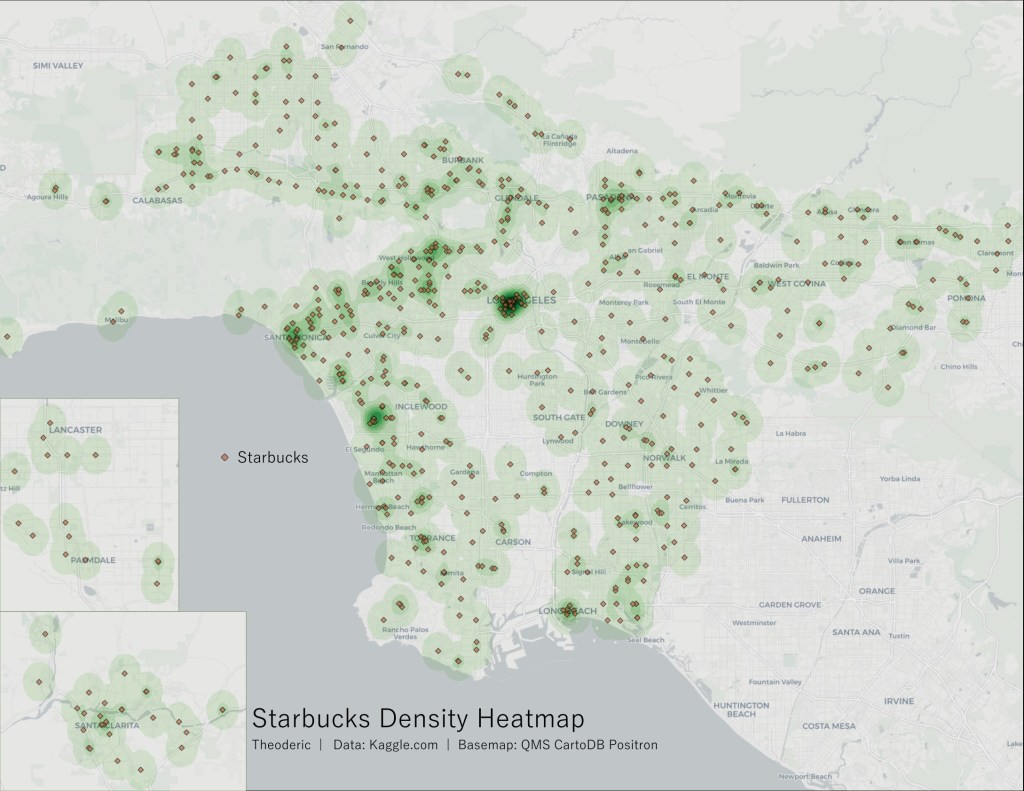
    Map 2: Starbucks Density Heatmap.

    A kernel density analysis results in a simple heatmap showing the distribution of Starbucks in LA County. At first glance, we see a few obvious dark spots on the map–Pasadena, Long Beach, LAX, Santa Monica, the Wilshire Corridor leading up to Hollywood, and, of course, Downtown Los Angeles. It’s clear from the heatmap that Downtown has the highest concentration of Starbucks, but I wanted to know more. I can walk to four Starbucks in under 10 minutes from the middle of Westwood Village; just how many Starbucks can I walk to in the same amount of time in DTLA?

    Map 3: Los Angeles County Walkable Starbucks Map

    To answer that, we need more than a heatmap. Wikipedia says that the average human walking speed is 1.42 meters per second. Multiplied by 600, a 10-minute walk would take you 852 meters. Here, I’ve rounded it to 850 meters or about 2790 feet. To count how many Starbucks we could walk to within 10 minutes, I created an 850m wide buffer around each Starbucks. The rationale is simple: if two buffers intersect at one point, it means that, from that point, you can walk to two Starbucks. By counting the number of overlapping buffers at each intersection, I arrived at the number of Starbucks within a 10-minute walking distance for every point in Los Angeles County.

    Note that the buffers are drawn as a circle with each Starbucks at the center and a radius of 850m. This does not take into account real-world factors that impact how far one can walk in 10 minutes, like road networks or pedestrian accessibility–all of which would likely slow down the hypothetical pedestrian. However, I would consider any Starbucks within a 15-minute or 20-minute walk to still be worth walking to (your mileage may vary), so an 850m straight-line distance, factoring in real-life conditions, should still work as a rough gauge of how many Starbucks are within my subjective walking distance.

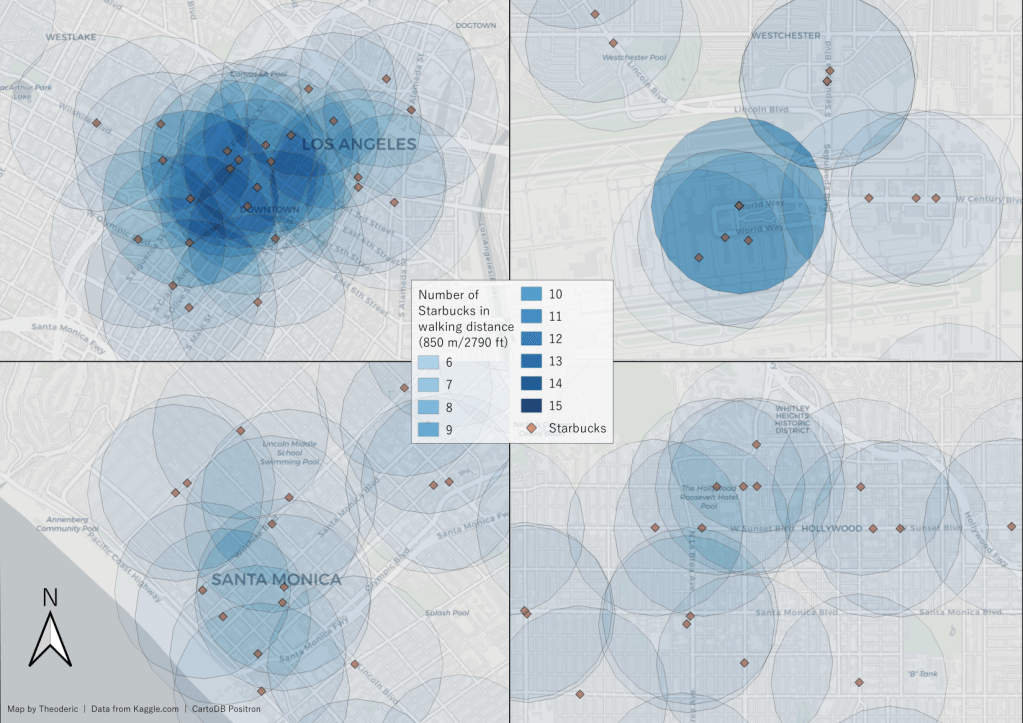
    Map 4: Four Areas with the Highest Concentration of Starbucks in LA County

    I selected the four areas in the county where the concentration of Starbucks locations is highest. As the heatmap had shown, DTLA is the densest, with most of the Financial District between the 110 and 101 freeways smothered in Starbucks. There are 4 small polygons with 15 Starbucks within walking distance in this area, making them ideal destinations for those with a particular craving for iced lattes. Honestly, I’m a little surprised. In my experience, there didn’t seem to be that many Starbucks in Downtown. Whether it is because some locations are hidden away in office towers and shopping malls or because some locations have closed since this data was compiled in 2017, I can’t say.

    Second place is LAX, where the multitude of airport terminals helps boost the concentration of Starbucks locations. Just off the eastern end of the north runway, one could hypothetically walk to any of the 10 Starbucks nearby. In actuality, it’s hard to see how anyone could go to even half of them, given that many are in terminals behind the TSA, to say nothing of the abysmal pedestrian infrastructure there.

    Downtown Santa Monica has a more genuine concentration of Starbucks, with the densest spots having access to 8 locations within walking distance. It’s not surprising that Santa Monica and Hollywood–with 7 walkable Starbucks on Sunset Boulevard just southeast of the Chinese Theater–came in third and fourth place. Both places have relatively dense commercial cores with a lot of foot traffic.

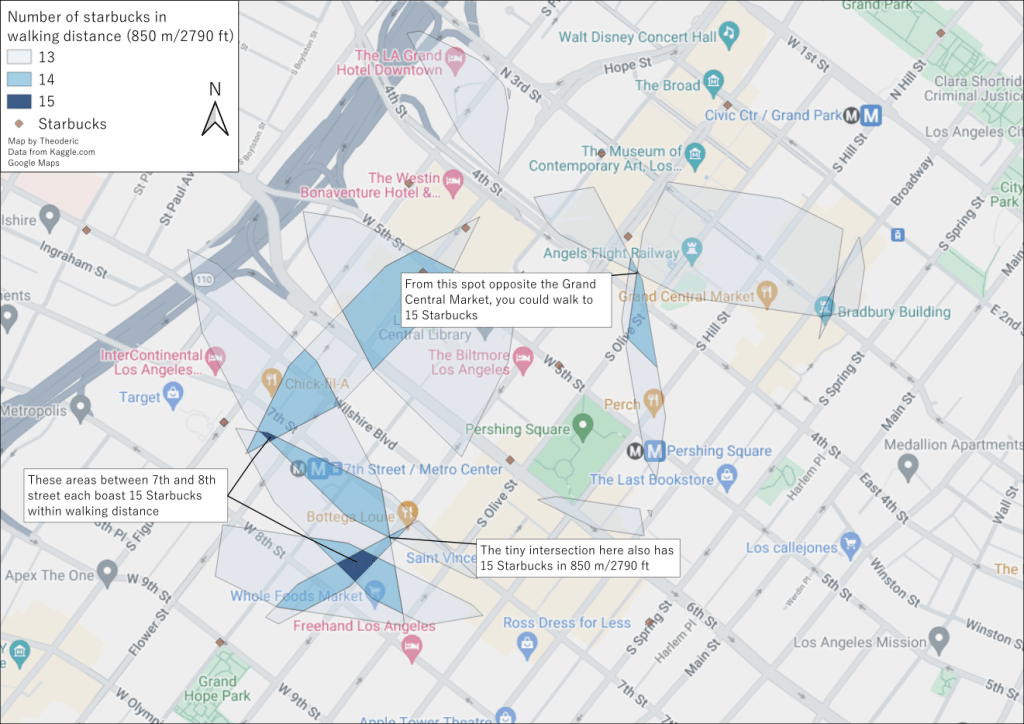
    Map 5: Downtown LA in Focus

    To finish it off, I wanted to focus on the four tiny spots in Downtown Los Angeles where the concentration of Starbucks–15 within walking distance–is the highest in the county. As the map above shows, apart from one tiny spot across from the Grand Central Market, the other three locations are all located in the few blocks bounded by 7th and 8th streets horizontally and Olive and Figueroa streets vertically. Given the abundance of shopping centers in and near the area (the Bloc, Figat7th) and its centrality in the Downtown area as a whole, this is within expectations. Still, I have yet to verify the situation on the ground. Someday, I’ll go and count up all the Starbucks myself–I’ll just have to try getting too hyped up on caffeine.


    References:

    Tools used:

    Detailed methodology can be found here

  • On microcosm, or the problem of scale

    July 10, 2023

    ONE of my favorite childhood stories is The Blind Men and an Elephant. There are many versions of this story, but they all go something like this:

    A group of blind men is tasked to figure out what an elephant is like. The first blind man touches the trunk and says: “The elephant is like a python.” The second man touches the tail and says: “No, it is like a rope of some sort.” Yet, the third touches the legs of the elephant and disagrees, “The elephant is like a tree!” The last blind man, reaching out and touching the body, proclaims authoritatively: “You’re all wrong. The elephant is like a wall.”

    “Blind monks examining an elephant” by Itcho Hanabusa. Wikimedia Commons

    Though the story has stuck with me since I first heard it in 7th grade, I clearly failed to take the lesson to heart. As a freshman in college, I was obsessed with the search for ontological truth–fundamental questions about the nature of reality, existence, and knowledge, the whole lot. I felt that if we couldn’t answer basic questions like these, then no one truly be certain about what they know. All academic pursuits would be moot.

    To assuage what would become my first experience with existential dread, I thought, quite naively at the time, that taking an introductory philosophy course might help. Predictably, I finished the class with far more questions than answers. Aristotle’s De Anima and Nietzsche’s Beyond Good and Evil proved unable to relieve my angst–if anything, they worsened it. Each philosopher seemed to make perfect sense to me when I read them, and I went from one to the other like a child who’s trying to pick his favorite toy in a toy shop. Looking back, I could have reduced my anguish if I’d remembered the simple lesson I learned in 7th grade.

    A standard reading of the Blind Men and an Elephant yields two related statements: (1) What is true for a part of the whole may not be true for the whole, vice versa; and (2) What is true from one perspective may not be true for another. These axioms are simple to learn but incredibly difficult to remember–as my own experience shows.

    That we frequently fail to realize the limitations of what we can see is the essence of what I call the “problem of scale.” No one can see the whole picture–the totality of every relevant information, context, and background. Even if one could, the amount of information would be so mind-boggling that they wouldn’t have the brainpower to make sense of it. However, the problem of scale wouldn’t be an issue were it not for our habit of forgetting how narrow our perspective really is. Our hubris makes us believe that we see more than we can see and, consequently, know more than we actually know. When we fail to address the limitations of our knowledge and understanding, we commit the same error as the blind men–knowing only a part yet speaking of the whole.

    Beyond fundamental questions of reality, the parable of the Blind Men applies equally to other disciplines and life’s daily problems. Heuristically, it is useful to reconcile differences in opinion by considering if there is a scenario where both sides can be at least partially correct. Multiple, seemingly contradictory truths can coexist under an overarching, reconciliatory Truth, and one does not preclude or invalidate the other. The blind men weren’t outright wrong, after all. They used the information available to them and drew reasonable conclusions from that information. In fact, they would have been entirely correct if they qualified their conclusions to the parts of the animal they touched–i.e., if they said that an elephant’s legs are like tree trunks or its tail is like a rope. What sunk their effort wasn’t their sense of touch or ability to use analogies. It was their inability to “see” the whole elephant and understand the limitations of their own perspectives. Similarly, any of us can be right and wrong at the same time, depending on how far we are willing to stretch what we know.

    The problem of scale manifests beyond the physical. Scale can also be temporal, social, or epistemological–the latter being the intellectual context a piece of knowledge is situated. Think of the Pandimensional Beings’ quest for truth in The Hitchiker’s Guide to the Galaxy. They waited ten million years for their super-intelligent computer, specifically designed to resolve the “Ultimate Question of Life, the Universe, and Everything,” to calculate an answer that made no sense to anyone. The computer’s calculations were correct, but it was useless to the makers–or rather, their descendants–who, for all their cleverness, had failed to define the scope of their question. This oversight condemned them to another ten million years of search for the Ultimate Question to make sense of the answer they got.

    Humans, like the pandimensional beings in The Hitchhiker’s, are similarly prone to the kind of epistemological arrogance that makes us jump to the answer before we know the question. Luckily, we can combat this. In some versions of the Blind Men and an Elephant, the blind men realize what was going on and work together to collectively “see” the whole elephant. In confronting our differences, we can do the same so long as we are willing to withold judgement, engage with sincerity, and most importantly, remain humble.

    This blog, Microcosm, is dedicated to the spirit of embracing the problem–or the beauty–of scale. For most of my life, I have been a recipient of knowledge. This blog is part of my effort to give back. Just as importantly, the pursuit of knowledge is a collaborative effort. We are like the blind men In the parable, except that the object of our pursuit is far bigger than any elephant, and the tools at our disposable no better suited for the task than the blind men’s hands were at theirs. We must work collaboratively if we hope to make progress.

    Microcosm is Greek for “small universe.” It represents the things that we see and experience directly. No one directly experiences the totality of abstract phenomena like the economy or racism; we experience them in myriad, microcosmic fragments—the price of groceries, the interactions we have with others, and the health effects of toxic environments. The microcosm framework demands that we approach issues holistically, conscious of the ways small things are connected with the bigger picture. It also encourages us to think in scale-shifting ways, imagining how our perspective and knowledge might shift depending on our position on the microcosmic-macrocosmic spectrum. Like looking at a chopstick in a glass of water, what we think about things changes depending on the angle we look at it.

    I want this blog to be a dynamic space, not least because I am new to blogging and will probably learn as much, and likely more, than you from this exercise. I want to write about my thoughts of things, big and small, articles I read or movies I watched, and my observations in both daily life and during travels. Microcosmic, perhaps, but instructive and thought-provoking nonetheless. As I climb up the steep slope of the learning curve, I welcome any and all constructive feedback. While I can’t say how this space may evolve in the future, I can assure you that I will always strive to deliver the highest quality content I can achieve. So, if I’ve managed to retain your interest thus far, then I wish you a warm welcome to the Microcosm!